
Ansarada Pricing and Plans: A 2026 Breakdown
Ansarada pricing is quote-based, not self-serve. It provides custom quotes, typically per deal or subscription, aimed at advisers and corporates. Here is how.

On this page
- How Ansarada prices its data rooms
- The per-page model, explained plainly
- A worked total-cost example
- Hidden costs to ask about before you sign
- Who Ansarada suits
- Why smaller teams often overpay
- When Plox is cheaper
- A cost framework: should you pay for Ansarada or go flat and self-serve?
- The flat, self-serve alternative
- Ansarada vs Plox: pricing and feature models compared
- An honest limitation
- How quote-based VDR pricing works in the wider market
- Frequently asked questions
- How much does Ansarada cost?
- Does Ansarada charge per page?
- Does Ansarada have a free plan?
- Is Ansarada billed per deal or per month?
- What drives the cost of an Ansarada data room?
- Is Ansarada worth it for a single fundraise?
- What is a cheaper alternative to Ansarada?
- How does Plox pricing compare to Ansarada?
- Stop guessing at quotes
I have requested an Ansarada quote, and I have also bought a flat data room for a single raise. The two experiences could not be more different, and the gap is mostly about how you get to a number.
Ansarada pricing is quote-based, not self-serve. You ask for a custom quote, and it comes back billed per deal or as an annual subscription, aimed at advisers and corporates running M&A, capital raises, and audits. What you pay tracks deal scope, data volume, user count, and which AI deal tools you bundle in. There is no public plan to pick from. You request a number instead.
How Ansarada prices its data rooms
Ansarada sits at the enterprise end of the virtual data room market. There is no public price list. You go through a sales conversation that ends in a tailored quote. That keeps pricing flexible for large transactions, and it also means you cannot know your cost before you talk to a rep.
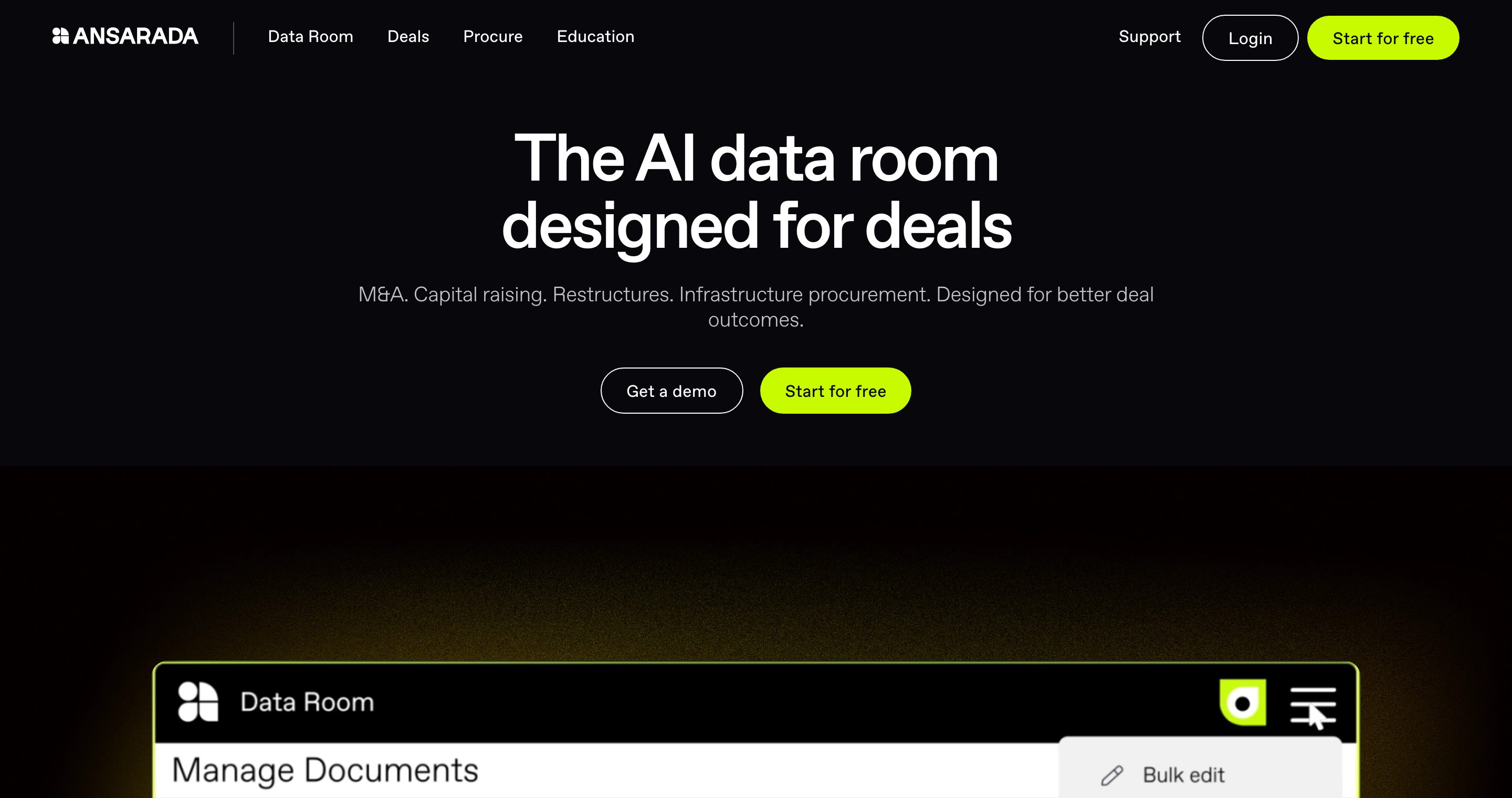
A few things drive an Ansarada quote:
- Deal or subscription model. You can buy access for a single transaction or commit to an ongoing subscription if you run deals regularly.
- Data volume and pages. Larger document sets and higher page counts generally push the cost up.
- User count and roles. More invited bidders, advisers, and administrators can affect the price.
- AI and deal tooling. Ansarada bundles deal scoring, readiness workflows, and reporting, and the tier you choose influences the quote.
- Term length. Longer commitments and multi-deal arrangements are negotiated case by case.
Every quote is assembled around your transaction, so two teams with similar needs can get different numbers. You lose the predictability a published price gives you. This is the same model the whole enterprise VDR category runs on, including iDeals, Datasite, Intralinks, and Firmex, so a figure someone quotes on a forum for their deal rarely matches the one you will be offered.
For the wider picture on how quote-based rooms are priced and what ranges look like in practice, the virtual data room cost guide breaks the category down. For a direct comparison against another sales-gated provider, see iDeals data room pricing.
The per-page model, explained plainly
If you have heard that data rooms are billed "per page," Ansarada is part of why. The legacy VDR pricing model, the one this whole category grew up on, charged you for the number of pages you loaded into the room, not the number of files or gigabytes. A 40-page contract and a 40-page contract with one 3,000-page appendix are very different invoices under that logic.
Here is the part that trips people up. A "page" in VDR pricing is not always a PDF page. Vendors that bill this way often count pages on a per-rendered-page basis, and a wide spreadsheet, a CAD drawing, or a slide deck can expand into far more billable pages than you would guess by eyeballing the file. Upload a folder of native Excel models and a financial diligence pack, and the page meter can run hot in a hurry.
Ansarada has moved its public messaging toward deal-based and subscription packaging rather than a raw per-page rate card, but the DNA is still there in how data-heavy rooms get scoped. More documents, more pages, more cost. The practical lesson holds across the category: the cost driver you most need to control is page volume, and the cheapest move you can make is to not dump everything into the room. Index tightly, redact what counsel does not need, and keep the appendix lean.
I do not have a confirmed published per-page figure to quote, and I am not going to invent one. The honest description is the model: data rooms in this tier are scoped against page count and document volume, and the quote reflects how much you load. If a rep gives you a per-page rate, write it down and use it to model your real document set before you sign.
A worked total-cost example
Quote-based pricing is hard to reason about in the abstract, so here is the kind of math I run before any data room decision. Treat the dollar figures as bracketed placeholders, because Ansarada does not publish them and I will not fabricate them. What matters is the shape.
Say you are running a Series A raise. Your diligence pack is about 600 pages: cap table, financials, contracts, a data-room-ready deck, and a couple of fat appendices. You expect 15 to 20 investors in the room over six weeks, and you will probably reopen the room for a bridge or a follow-on within the year.
- Enterprise VDR, single deal. A scoped room for one transaction, billed per deal, plus the page volume above, plus a handful of admin and adviser seats. Call it a single per-deal fee scoped to the transaction term. Onboarding is sales-assisted, so add a few days before the room is live.
- Reopen for the follow-on. Per-deal billing means the second raise is a second charge. Another per-deal charge at the same rate. If you transact twice a year, you are paying the per-deal premium twice.
- Overage risk. If your appendices balloon past the scoped page count, or you add a late bidder list, the quote can move. This is the line item nobody models up front.
Now run the same raise on a flat, published plan. You pay a known monthly or annual rate, the room is live the same afternoon, the follow-on does not trigger a new contract, and there is no page meter to watch. For a single straightforward raise, the flat number usually wins on both cost and time-to-live. For a regulated, multi-bidder sell-side process with counsel attached, the enterprise room earns its premium. The example is meant to show you which world you are actually in, not to claim one beats the other every time.
Hidden costs to ask about before you sign
The quote you are shown is rarely the all-in number. These are the line items I have learned to ask about explicitly, because they tend to surface after the verbal price:
- Page overage. If you exceed the scoped page count, what is the per-page or per-block rate? Get it in writing.
- Extra users and roles. Are bidders, advisers, and admins all counted the same? Some models charge for guest seats, some do not.
- Per-deal vs annual gap. A second transaction inside the year can cost as much as the first under per-deal billing. Ask for both quotes side by side.
- Onboarding and support tiers. Hands-on setup and premium support can sit in a higher bracket than the base room.
- Auto-renewal and early termination. Annual contracts often auto-renew, and exiting early is rarely free. Read the term.
None of this makes Ansarada a bad product. It makes the sticker price an incomplete one, which is exactly the friction a published rate card removes.
Who Ansarada suits
Ansarada is built for people who run formal deals as a core part of their job. That includes:
- Investment banks and corporate finance advisers managing sell-side processes.
- Corporates running acquisitions, divestitures, or board and audit workflows.
- Law firms and accountancies coordinating large due diligence exercises.
If you run many high-stakes transactions a year and want bundled AI deal tooling, deal scoring, and hands-on onboarding, the sales-assisted model can fit. Larger organisations usually have the budget and process maturity to use it.
To be fair to Ansarada, this is where it is genuinely strong. The deal-readiness scoring and workflow tooling are purpose-built for advisers who run sell-side processes back to back, and the bundled AI helps a deal team get a messy document set into a defensible, indexed state. For a regulated, multi-bidder M&A process with a long bidder list, that structure earns its keep. If that is your daily job, the quote model works in your favour, because it lets a sales engineer scope the room to a complex transaction.
Why smaller teams often overpay
The trouble starts when a founder, a small fund, or a mid-market operator buys an enterprise data room for a single raise or sale.
- You pay for breadth you will not use. Advanced deal-readiness scoring and adviser tooling add cost even when your deal is straightforward.
- Quote-based pricing favours the seller. Without a public anchor, you negotiate blind and rarely know whether you got a fair number.
- Setup takes time. Sales-assisted onboarding adds days before your room is live, which hurts when a diligence request lands today.
- Per-deal billing punishes frequency. If you share documents often, repeated per-deal charges add up faster than a flat subscription.
For most founders the job is simpler. Share a deck or a diligence folder securely, see who opened it, control access. That does not require an enterprise deal suite. The same logic applies to early funds and operators, which is why the best data room for startups conversation has moved away from legacy VDRs toward flat, self-serve tools.
When Plox is cheaper
Flat pricing is not automatically cheaper than a quote, so here is the honest read on when it actually is. Plox tends to win on total cost in these cases:
- One raise, or a couple a year. A flat subscription you can pause or downgrade beats paying a per-deal premium each time you reopen.
- Modest page volume. If your diligence pack is hundreds of pages, not tens of thousands, you are paying enterprise page-scope rates for a room a flat plan handles on a normal tier.
- You want to start today. No sales call, no MSA, no onboarding window. The room is live in minutes, and the time you save is real money during a live process.
- You mostly need secure sharing plus analytics. If the core job is a trackable link and a clean data room with engagement metrics, the enterprise deal suite is breadth you are renting and not using.
Where the quote can still come out ahead: a large, regulated sell-side process where the bundled deal-readiness tooling and adviser workflows replace work you would otherwise pay a team to do. In that world the enterprise room is doing more than hosting files, and the premium is buying labour, not just storage. Match the spend to the job.
A cost framework: should you pay for Ansarada or go flat and self-serve?
Before you book a sales call, run your situation through this. Score one point for each statement that is true for you.
- You run more than three formal, multi-bidder deals a year.
- Your deals involve regulated diligence, audit trails for counsel, and long bidder lists.
- You need bundled deal-readiness scoring and adviser workflow tooling, not just secure sharing and analytics.
- You have budget approval for an annual enterprise contract and time for sales-assisted onboarding.
- Procurement requires a named vendor with formal security attestations and a signed MSA.
4 to 5 points: an enterprise VDR like Ansarada is a reasonable fit. Get competing quotes (iDeals, Datasite, Firmex) so you have an anchor to negotiate against, and ask for per-deal and annual pricing side by side.
0 to 3 points: you are almost certainly overpaying for breadth you will not use. A flat, self-serve platform will be cheaper, live in minutes, and still give you secure links, granular access control, and page-by-page analytics.
That is the honest split. If you land at 4 or 5, the rest of this article matters less than getting three quotes. If you land at 0 to 3, read on.
The flat, self-serve alternative
Plox prices the opposite way. The plans are flat and published, so you see the cost before you commit, and you can start in minutes without a sales call.
Plox gives you secure, trackable links and virtual data rooms with page-by-page analytics on every plan, including Free. The link never changes, so you can update the file anytime without resending. You see who opened it, how long they spent on each page, completion percentage, and you get a real-time notification the moment a viewer opens the document. As your needs grow you move up tiers on your own terms:
- Free. Secure trackable links with page-by-page analytics and real-time view notifications. No credit card, no time limit.
- Pro. More control over how your documents are shared and viewed, plus custom branding and a custom domain.
- Team. Adds dynamic watermarking and a data room for collaborative sharing.
- Data Rooms. Unlimited rooms, file-level permissions, one-click NDA gating, and Ploxie AI that answers viewer questions from your documents, with a 14-day trial.
You get the analytics that matter, who viewed what and for how long, without the enterprise overhead. Document control sits on top: passcodes, email verification, allow or deny download, link expiry, and one-click revoke. For a side-by-side view, see the Plox vs Ansarada comparison.
Ansarada vs Plox: pricing and feature models compared
| Dimension | Ansarada | Plox |
|---|---|---|
| Pricing model | Custom quote, often per deal | Flat, published, self-serve |
| Page-based cost | Lineage in per-page VDR billing | No page meter, flat tiers |
| Free plan | No | Yes, no credit card, no time limit |
| Free analytics | Not applicable | Page-by-page on every plan |
| Data rooms | Enterprise deal rooms | Virtual data rooms with folders and metrics |
| Watermarking | Available in enterprise tooling | Dynamic per-viewer watermarking |
| One-click NDA | Configurable in workflow | Built in, one click |
| Security and compliance | Enterprise attestations, audit trails | Passcodes, email verification, expiry, revoke, watermarking |
| AI features | Deal scoring and readiness workflows | Ploxie AI answers viewer questions from your docs |
| Setup | Sales-assisted, several days | Self-serve in minutes |
| Best for | Advisers and corporates running deals | Founders and mid-market teams |
The right choice depends on how you work. If you are an adviser running constant, complex deals and you value bundled AI deal tooling, Ansarada is designed for you. If you are a founder or mid-market team who wants predictable pricing, a free starting point, and analytics on every link, a flat self-serve platform like Plox will usually cost less and move faster.
An honest limitation
Plox is not the right tool for every situation. If your deal is a regulated, multi-bidder M&A process where counsel demands enterprise security attestations, formal redaction workflows, and adviser-grade deal-readiness scoring, an enterprise VDR is the safer call. Plox is built to be the fast, transparent, founder-native way to share documents and run lean data rooms. It is not a replacement for a full sell-side deal suite. If procurement hands you a checklist written for Datasite or Ansarada, match the tool to the checklist.
For most founders and operators, though, that checklist does not apply, and the enterprise suite is overkill for a single raise.
How quote-based VDR pricing works in the wider market
Ansarada is not an outlier. Quote-based, sales-gated pricing is the norm across the legacy VDR category. The model exists because enterprise software vendors price on value captured per transaction rather than a published rate card, and because large deals genuinely vary in scope. Industry coverage of the data room market, such as the Wikipedia overview of virtual data rooms, describes the same pattern: rooms billed per page, per user, or per project, with pricing set during a sales process.
The practical takeaway is simple. If you go the enterprise route, never accept the first quote without an anchor. Get two or three competing quotes so you can negotiate. If you do not need the enterprise feature set, skip the negotiation entirely and use a tool with a published price.
Frequently asked questions
How much does Ansarada cost?
Ansarada does not publish fixed prices. It provides custom quotes based on your deal scope, data volume, user count, and the AI deal tooling you include. Costs are commonly structured per deal or as an annual subscription, so you contact Ansarada to get a number for your situation. Two teams with similar needs can get different quotes.
Does Ansarada charge per page?
The legacy VDR category, Ansarada included, grew up on per-page billing, where your cost tracks the number of pages loaded into the room rather than the number of files. Public messaging has shifted toward deal-based and subscription packaging, but page and document volume still drive the quote, and a "page" can expand for wide spreadsheets and large attachments. If you go this route, ask for the per-page or overage rate in writing and model it against your real document set.
Does Ansarada have a free plan?
Ansarada is positioned as enterprise deal and data room software and does not offer a flat free plan the way a self-serve tool does. If you want a genuinely free starting point with analytics, Plox includes a Free plan with secure trackable links and page-by-page analytics, no credit card and no time limit.
Is Ansarada billed per deal or per month?
Both models exist. You can buy access for a single transaction, or commit to an ongoing subscription if you run deals regularly. The structure and price are set during the quote process, so the right fit depends on how often you transact. If you share documents often, a flat subscription usually beats repeated per-deal charges.
What drives the cost of an Ansarada data room?
The main cost drivers are deal scope, document and page volume, the number of users and roles, the term length, and which AI and deal-readiness tools you include. More scope and more tooling generally mean a higher quote. This matches how the wider quote-based VDR market prices, which you can read about in the virtual data room cost guide.
Is Ansarada worth it for a single fundraise?
For one straightforward raise, the enterprise feature set and sales-assisted setup can be more than you need. A flat, self-serve data room lets you share securely and track engagement without negotiating a custom quote. Run the cost framework above. If you score 0 to 3, you are likely overpaying.
What is a cheaper alternative to Ansarada?
Plox is a flat, published, self-serve alternative built for founders and mid-market teams. It offers secure trackable links and data rooms with page-by-page analytics on every plan, plus dynamic watermarking, file-level permissions, one-click NDA, and Ploxie AI on higher tiers. For early teams specifically, see the best data room for startups guide.
How does Plox pricing compare to Ansarada?
Plox uses flat, published pricing you can start for free, while Ansarada uses custom quotes aimed at advisers and corporates. See the full Plox vs Ansarada comparison for a feature and pricing breakdown.
Stop guessing at quotes
If your next raise or diligence process does not need an enterprise deal suite, you do not need an enterprise quote. Start free on Plox, share a secure trackable link or spin up a virtual data room in minutes, and see exactly who opened what, page by page, with no sales call and no surprise invoice.

Written by Rohan Nayak · Co-founder, Plox
Rohan co-founded Plox. He spends most of his time with founders working out how to share a deck or a data room without losing control of it.
Connect on LinkedIn