

AI Decision Models for Moderation
Musubi’s PolicyLM-1.7B brings decision-model speed and flexibility to real-time content moderation.
AIContent Moderation
Gizmodo reports that Google DeepMind’s WeatherNext Cyclones AI model can give forecasters an extra day of warning while improving cyclone track, intensity, and wind-structure predictions.

Google DeepMind’s WeatherNext Cyclones is described as a highly accurate AI weather model that gives forecasters an extra day of warning for tropical cyclones. The model focuses on a long-standing forecasting challenge: predicting both a storm’s track and its intensity with useful lead time. Gizmodo named Google DeepMind a winner of the 2026 Gizmodo Science Fair for the work.
The practical takeaway is straightforward: more accurate warning time can help forecasters and emergency planners act earlier when storms threaten communities.
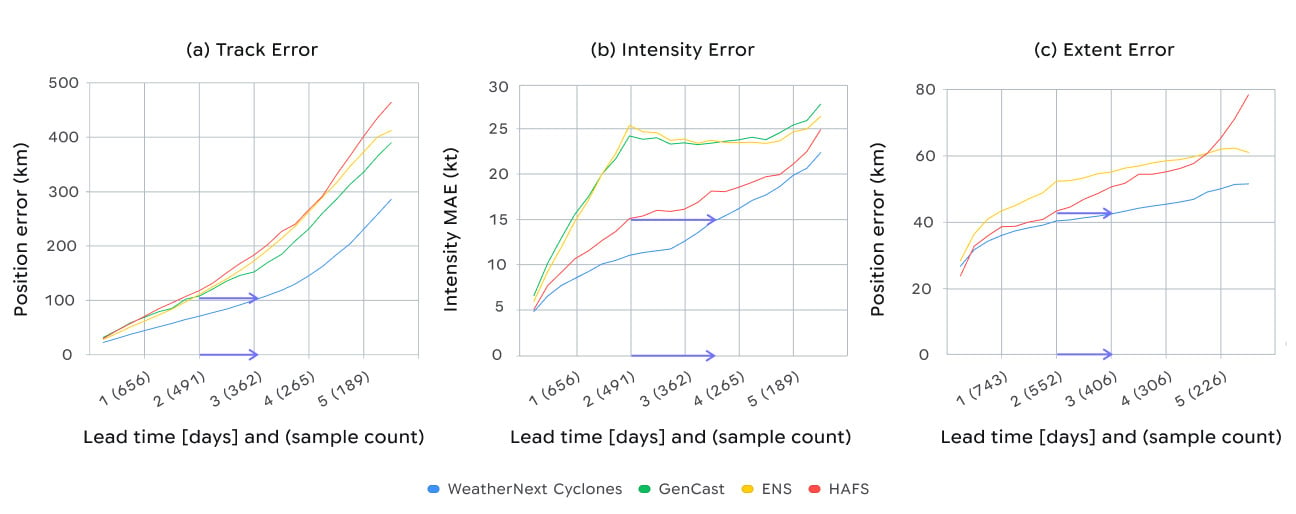
According to the article, WeatherNext Cyclones achieved state-of-the-art accuracy in predicting cyclone track, intensity, and wind structure. A Nature study cited in the article evaluated the model on historical cyclones and found that, on average, it provides more than 24 hours of lead-time advantage.
During its first operational run, the model helped the National Hurricane Center predict Hurricane Melissa’s rapid intensification and Jamaica landfall with about 80% confidence five days in advance, rising to nearly 100% confidence three days before landfall.

The article explains that traditional physical models are built on the laws of physics, while machine-learning models use AI and historical data to extrapolate storm formation, intensification, and movement. Cyclone track and intensity are hard to predict together because large-scale atmospheric currents steer storms, while localized processes near the storm center drive intensity.
That tradeoff has real consequences. Gizmodo points to Hurricane Otis in 2023, when physical models failed to predict rapid intensification before landfall on Mexico’s Pacific coast, leaving communities unprepared.
WeatherNext Cyclones is positioned as important because climate change is increasing the stakes for tropical cyclone forecasting. The article notes projections under 3.6 degrees Fahrenheit, or 2 degrees Celsius, of global warming that tropical cyclone intensities could increase by an average of 1% to 10% globally, with rainfall rates and rapid intensification also projected to rise.
The model can generate up to 1,000 possible scenarios, which may help it capture rare but damaging “gray swan” extremes. Gizmodo also reports that WeatherNext Cyclones is open-sourced on GitHub, does not require a supercomputer to run, and is available through DeepMind’s Weather Lab platform.
WeatherNext Cyclones is currently used by experts at the National Hurricane Center, the Cooperative Institute for Research in the Atmosphere at Colorado State University, and the U.K. Met Office. The DeepMind team hopes to expand partnerships because cyclones affect regions beyond the U.S. and Caribbean, including the West Pacific, Australia, and India.
The bottom line: AI will not remove uncertainty from weather prediction, but this model shows how AI can push forecast accuracy forward and give at-risk communities more time to prepare.
Musubi’s PolicyLM-1.7B brings decision-model speed and flexibility to real-time content moderation.

The AI cloud startup is seeking up to $4B before a planned 2027 IPO.

The open source document editor is keeping AI out of its default installation for privacy reasons.

Ex-Ramp engineers pivoted Melius from ad-spend optimization to AI-generated campaigns, images, and videos.