
Nuclear Funding Surges, Markets Cool
Nuclear startups are drawing record funding, but public-market enthusiasm has weakened.
Nuclear EnergyVenture Funding
Third-generation Texas oilman Doug Robison pivoted from petroleum to next-generation nuclear energy, founding Natura Resources after a chance encounter at Abilene Christian University. With over 2,000 hours of molten salt system operation, an NRC construction permit in hand, and plans for a commercial reactor by 2032, Natura is racing to power AI data centers and desalinate water in West Texas.
Fortune
How a third-generation Texas oilman transformed an organic farming company into a leading advanced nuclear startup at a small Christian college
Fortune
How a third-generation Texas oilman transformed an organic farming company into a leading advanced nuclear startup at a small Christian college
Nuclear Regulatory Commission
NRC Issues Abilene Christian University Construction Permit
World Nuclear News
Construction permit granted for molten salt research reactor
Nearly a decade ago, third-generation Texas oilman Doug Robison was preparing to retire and sell his petroleum company when a visit to Abilene Christian University (ACU) — his children's alma mater — permanently altered his trajectory. He heard a brief talk from Rusty Towell, director of the school's Nuclear Energy Experimental Testing (NEXT) lab, on the potential of next-generation molten salt reactors to provide affordable, clean power. Robison cornered Towell after the talk and offered to fully fund the research. Two weeks later, Towell had a plan; Robison said yes on the spot.
Robison's initial $3.2 million research donation set the effort in motion. Then-U.S. Energy Secretary Rick Perry dispatched a team to Abilene to evaluate the work, and in 2019 the Department of Energy offered to supply fuel and salt if the university agreed to host a test reactor. ACU accepted. Robison then repurposed the dormant corporate shell of an organic farming company he had founded in the 1980s — named Natura — and reincorporated it as a next-generation nuclear startup. "It's a transition from organic agriculture to advanced nuclear," Robison told Fortune. "They both still involve clean energy."
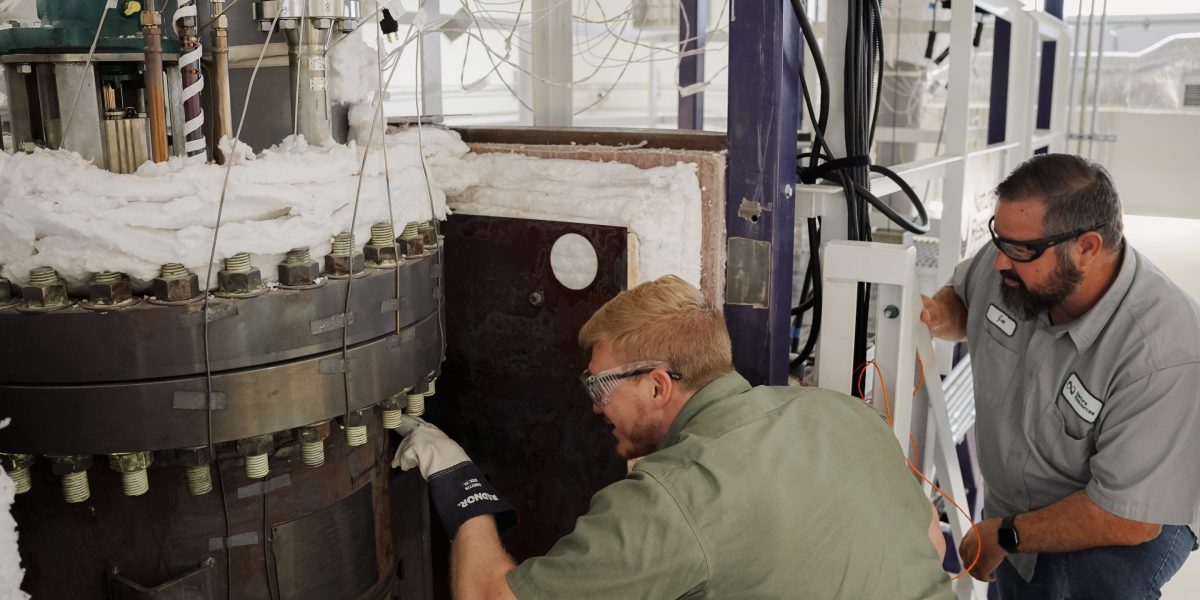
Natura Resources is developing molten salt reactors (MSRs), a type of Generation IV advanced reactor that dissolves nuclear fuel directly into a liquid salt mixture. Unlike conventional light-water reactors that operate under high pressure, MSRs require no pressurization: if something goes wrong, the fuel stays trapped in the salt. "It's radioactive, but it's contained," Robison said. Natura's test system has surpassed 2,000 hours of operation, with more than 1,750 of those hours running autonomously.
The Nuclear Regulatory Commission issued ACU a construction permit for the Molten Salt Research Reactor (MSRR) — the first such permit ever granted for a liquid-fueled advanced reactor — in September 2024, ahead of the agency's own public milestone deadline. The first test reactor, MSR-1, is targeted to come online in Abilene by 2028. A 100-megawatt commercial reactor is planned for West Texas's Permian Basin or near Texas A&M in Bryan by 2032, to be built with Teledyne Brown Engineering and Zachry Nuclear. Natura's university alliance now spans more than 150 researchers from ACU, UT Austin, Texas A&M, and Georgia Tech.
Natura is part of the Trump administration's Nuclear Reactor Pilot Program, which initially involved 10 companies and set a goal of achieving criticality on at least three test reactors by July 4, 2026 — the same date the administration ended subsidies for wind and solar projects. Natura did not meet that specific milestone, but neither did the best-known names in the sector: Google-partnered Kairos Power, Bill Gates-backed TerraPower, Sam Altman-backed Oklo, or Amazon-backed X-energy. The three companies that did announce criticality successes — Antares Nuclear, Valar Atomics, and Deployable Energy — are focused on smaller microreactors for industry or military use, not utility-scale grid power.
Natura's COO Jordan Robison (Doug's nephew) draws a sharp distinction between a criticality test and a functioning reactor system. "There is a difference between a criticality test and building a full reactor system," he said. Natura's focus is on demonstrating it can build, license, and operate a complete reactor — the prerequisite for attracting the investor and hyperscaler capital needed to scale commercially in the 2030s. "There's probably close to 100 projects out there now because there's so much money flying around," Doug Robison said, adding that only a small handful of companies are actually constructing next-gen reactors.
Natura is eyeing West Texas's Permian Basin as its first commercial reactor site for reasons that go beyond AI data center power demand. Oil and gas production in the Permian generates large volumes of chemically polluted produced water, and Natura argues the heat output from its reactors can be used to desalinate that water. The company is already working with NGL Energy Partners, which operates a large water solutions business. "We can generate clean power. And we solve the air emissions issue in the Permian Basin. We start solving the water problem, and we return usable water to the inventory of Texas," Robison said.
Robison frames the commercial scaling challenge in oil-patch terms: the company must de-risk the technology to the point that institutional investors commit capital, just as they did when the Permian shale boom transformed U.S. energy. "When that money hit the table, everything changed. Steel mills opened up. An industry was stood up, and we made the nation energy independent. That's exactly what we're doing now," he said. Natura still needs to attract significant outside funding to reach commercial scale, and its levelized cost of electricity is projected to be competitive with natural gas — without subsidies.
Nuclear startups are drawing record funding, but public-market enthusiasm has weakened.

The nuclear startup is funding product development, regulatory work, fuel purchases, and hiring.
Five vendors will build nuclear microreactors at five Army bases under the Janus Program.

TerraPower’s built-in energy storage could help nuclear power better match AI data center demand swings.