

AI Researchers Warn of R&D Automation Risks
More than 20 AI researchers say automated AI research could accelerate progress and strain oversight.
AI SafetyAI Agents
Google DeepMind’s WeatherNext Cyclones, or WN-C, is an AI system for tropical cyclone forecasting that can predict storm tracks and intensity in one model. The Decoder reports that it forecasts about one day further ahead than leading operational models and is available as open source.

Google DeepMind is introducing WeatherNext Cyclones, or WN-C, as an AI system for tropical cyclone forecasting. The key claim is that it can forecast about one day further into the future than leading operational models, a gain The Decoder describes as roughly matching a decade of progress in traditional weather forecasting. Unlike systems that specialize in either storm path or strength, WN-C is designed to predict both track and intensity in a single model.
Cyclone forecasting has traditionally involved a tradeoff: global models can be strong on track prediction, while specialized regional models can be better for intensity. According to the report, WN-C addresses both tasks together and improves on several benchmarks cited in the article. For a five-day forecast, the storm center position error is reported at 230 kilometers, compared with 370 kilometers for ENS and 335 kilometers for GenCast.
WN-C works on a grid where each point covers about 28 kilometers, which The Decoder says is roughly a hundred times coarser than specialized regional models. Even a compact version using 111 kilometers per grid point is described as competitive. The report notes that how the model produces such accurate forecasts at this resolution remains an open research question.
The system uses Functional Generative Networks rather than the diffusion approach used by GenCast. The Decoder reports that this lets WN-C run with a single pass per forecast step and makes it eight times faster. A 15-day forecast can run in under a minute on one of Google’s AI chips, allowing DeepMind to scale from 50 to 1,000 parallel forecast runs per storm.
DeepMind has released the code and model weights for WeatherNext 2 and WeatherNext Cyclones on GitHub, according to the report. The article also emphasizes that WN-C is positioned as a tool to support forecasters, not replace national weather services. For official warnings, users are still directed to national weather agencies.
More than 20 AI researchers say automated AI research could accelerate progress and strain oversight.
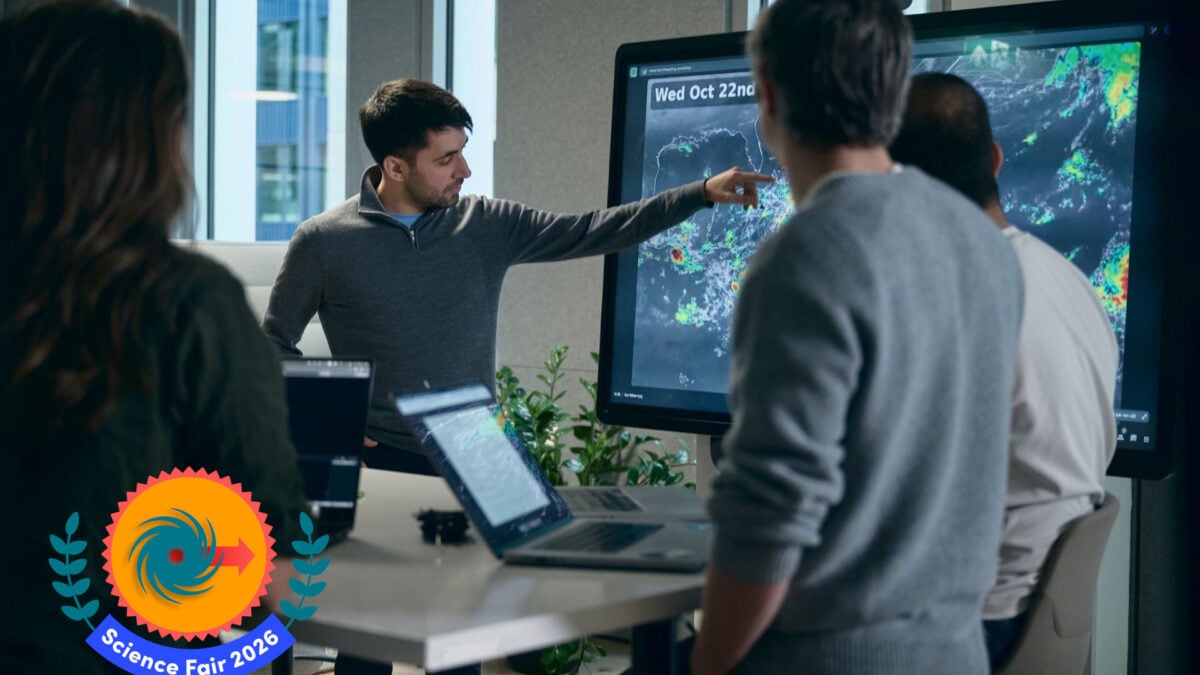
WeatherNext Cyclones gives forecasters more lead time on dangerous tropical cyclones.

Boris Power says 80 to 90 percent of OpenAI research targets GPT-7 and beyond.

HomeBody lets GPT-6 Astra call robot skills directly for navigation, grasping, and drawer-opening tasks.